
Overview
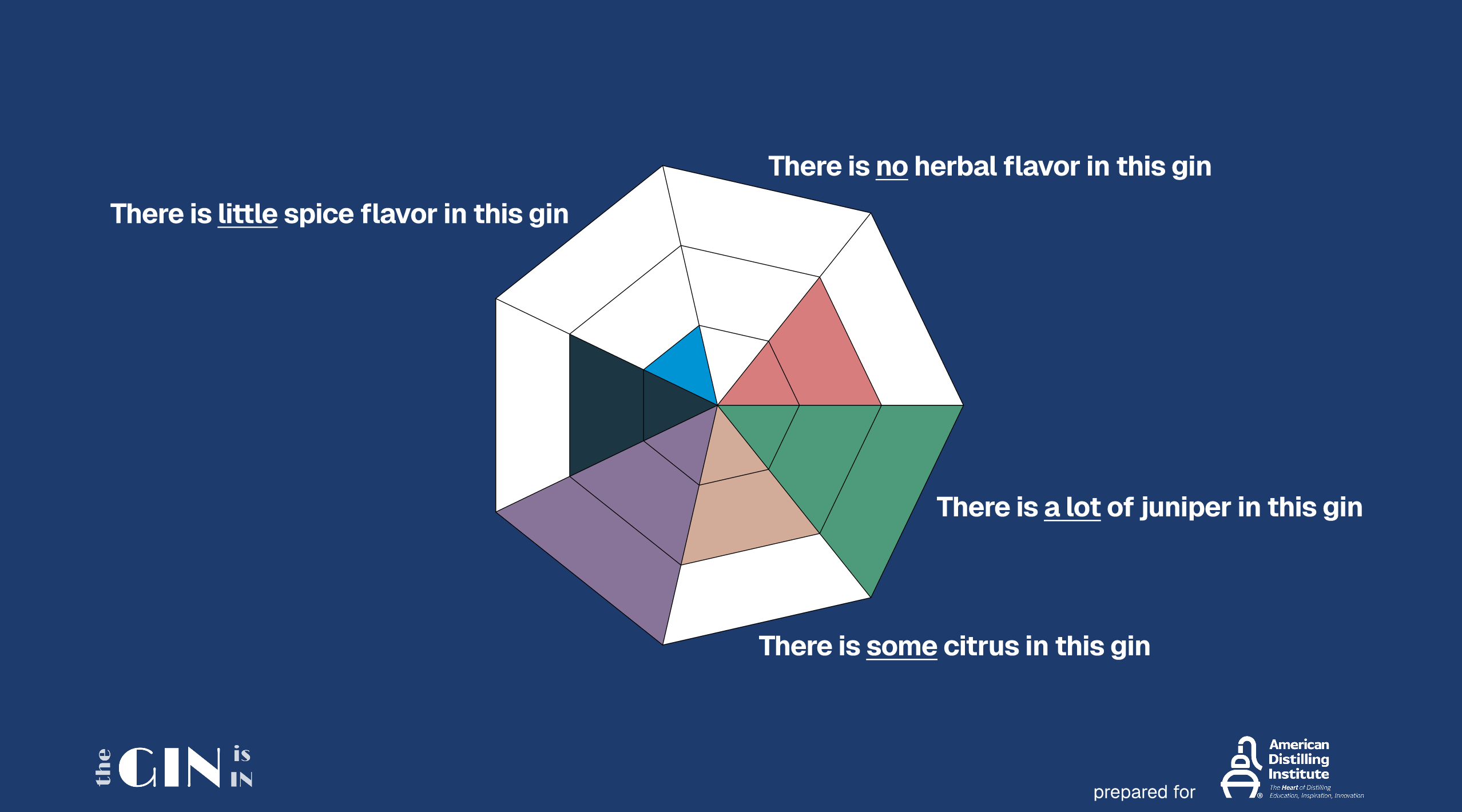
In 2011, I created a new way to describe gin flavor. Not by listing botanicals, but by translating how real drinkers talk into a clear, approachable visual. The result was the Gin Flavor Map, a language-first, non-technical flavor model that uses familiar terms (“heat,” “floral,” “citrus”) and avoids false precision by using “a lot,” “some,” “a little,” or “none.”
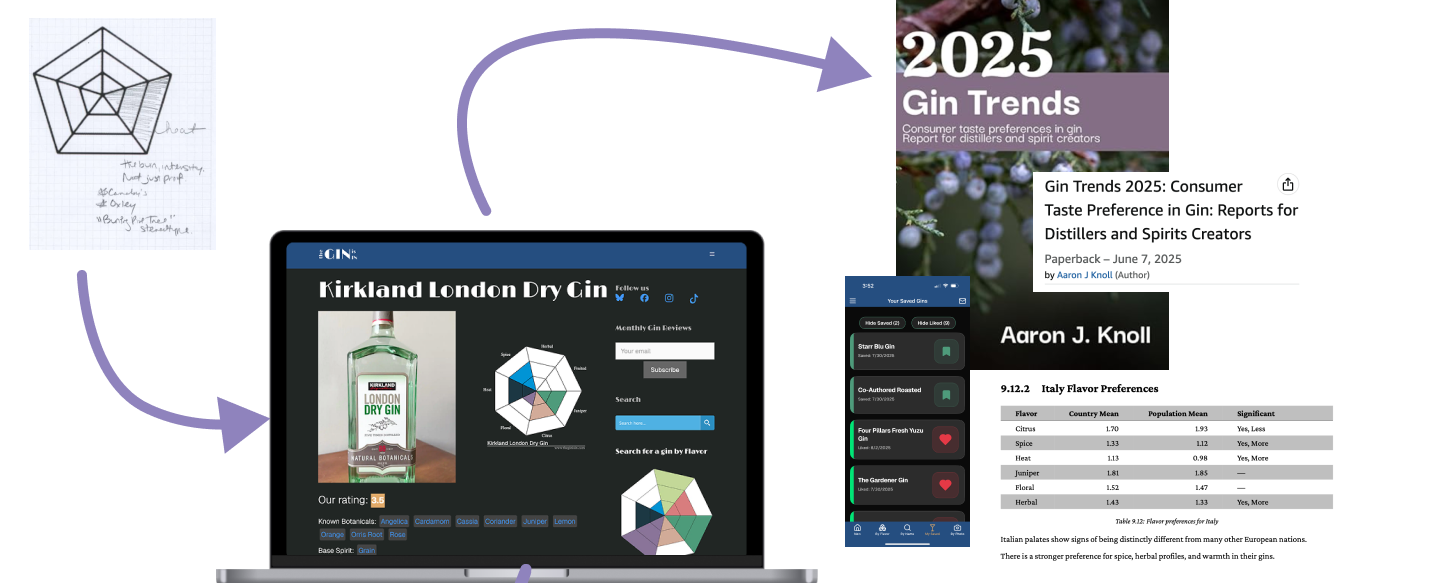
What began as a research-led visualization became an eight-year dataset, a search engine, and now a native app. All have been designed and built by me. Over the years, it has been adopted, adapted, and copied widely across the industry.
This case study shows how an insight from ethnographic research became a scalable, enduring product ecosystem. Further, how I’ve used design to iterate on and keep it relevant over a decade.
Context & Challenge
Gin producers often described products in terms of botanicals (e.g. “angelica,” “orris root”), but most consumers had never tasted them — and even familiar botanicals, like lavender, could present differently based on distillation choices.
Casual drinkers needed a shared, intuitive language for describing flavor. The challenge was to make it:
- Accessible to non-experts.
- Flexible enough to describe the full range of gins on the market
- Reliable for search and comparison without over-promising precision.
Goals
- Develop a flavor vocabulary rooted in real, everyday language.
- Create an approachable visual model that scales to a growing dataset.
- Enable search by flavor — not just name or brand.
- Track and publish flavor trends over time for industry and consumer audiences.
Approach
Research-Led Innovation
- Conducted ethnographic research: conversations at bars, tasting events, and site feedback from readers.
- Documented common descriptors (“heat” vs. “ethanol forward”) and mapped them to scalable flavor categories.
- Developed the four-level intensity scale (“a lot,” “some,” “a little,” “none”) and core flavor scale (“floral,” “citrus,” “spice,” “herbal”) to reflect the way everyday people talk about new flavors.
Design & Development
- Designed the Gin Flavor Map visualization and all UI flows.
- Implemented the entire app, leveraging AI-assisted coding tools (e.g.: Copilot, ChatGPT).
- Built a search engine using my database of 1K reviews.
- Supported multiple search paths: OCR label recognition for photo-based bottle searches, product name, and flavor.
Analytics & Reporting
- Tracked flavor search behavior over eight years.
- Published annual reports summarizing trends by year, region, season, and demographic.
- Delivered insights to distillers via Amazon-published books and industry magazine articles.
Scalability & Evolution
- Expanded from a static visualization to a searchable dataset to a native app.
- Currently developing a “mad libs” style flavor search for improved accessibility.
Outcomes & Impact
- Industry Influence: Visualization model widely adopted (and sometimes emulated) by others.
- Unique Data Insights: Identified macro-trends, e.g.: (Did you know citrus is the top flavor in gin worldwide? Did you know consumers in Asian markets prefer “floral” flavors more than the rest of the world?)
- Thought Leadership: Speaker at industry events including ADI Annual Conference, Gin Summit, Craft Spirits Expo, and Gin World (to name a couple).
- Product Delivery: Designed, coded, tested and shipped a fully functional consumer app without external development support. You could call it “vibe coding” or a bit of “design engineering.” (I know a bit of code, but Copilot tools helped quite a bit)
Why This Matters for a Hiring Manager
This project demonstrates:
- Strategic Insight: Seeing beyond industry norms to create a user language that sticks.
- Full-Stack Execution: Research, design, code, analytics, repeat
- Sustainable: Built to grow! Built to be built upon.
- Thought Leadership: Driving industry-wide conversation through writing and speaking.
I specialize in taking an insight from qualitative research and turning it into a product that lasts. Durable products delivering both immediate user value and a foundation for long-term growth.
I bridge research, design, and development to create tools and frameworks that scale. Sound good? Let’s talk!